
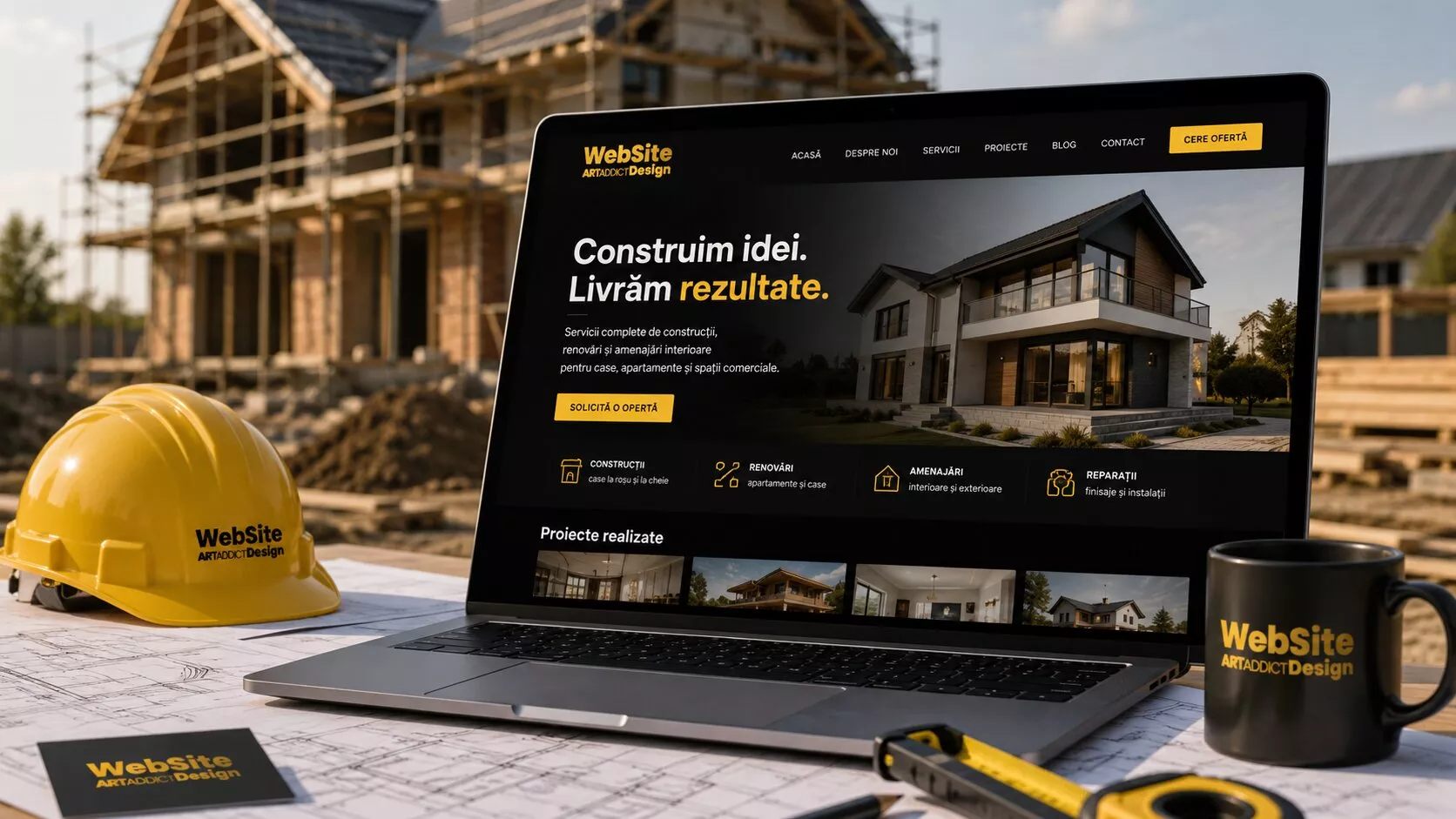
The job type, location, approximate size and desired time frame are enough for many first construction enquiries. Describe the work you take on and explain what each project photo illustrates. People should be able to submit an enquiry easily on their phones.
Put a past job near the service description and explain what the crew delivered. State which requests you take on and the areas you cover. Visitors can then judge fit before writing.
In the construction sector, trust matters enormously. The client's not just looking for a firm that does "works." He wants to see if the firm looks serious, organized and suitable for his project.
Before calling or asking for an offer, the client wants to understand quickly:
- what type of works the firm does;
- whether it has relevant experience;
- whether it has worked on similar projects;
- how the work is done;
- how the collaboration begins;
- and whether it is worth sending an offer.
The site plays a much more important role here than many entrepreneurs think.
A good site is not just an online business card. For a construction firm, it can directly influence the quality of the applications, how the firm is perceived and the level of trust before the first call.
What does more serious demands mean for a construction firm?
When we talk about more serious demands, we don't just mean more phones or more messages.
A construction firm needs requests:
- clearer,
- closer to the services it provides;
- came from clients who already understood something about the firm;
- better formulated;
- and suitable for the type of projects that the firm can take over.
A weak demand often sounds like this:
- "How much?"
- "Are you doing that, too?"
- "I need it urgently."
- "Send me a price."
No details, no context, no surface, no type of work and no project information.
Instead, a better request usually comes from someone who:
- read what services you offer;
- has seen examples of works;
- understood whether the firm fits it;
- knows what information you need to send;
- He's already got a minimum of trust.
That's the difference between a website that just exists and a website that works for the firm.
Why does the site matter so much in construction and repairs?
In construction, the customer does not buy a simple product off the shelf. He buys work, time, organization, experience and promise that the work will be done correctly.
For a customer, choosing a construction firm can mean a significant investment. It can be about renovating an apartment, building a house, setting up a commercial space or complex repairs.
That's why people are looking for reliable signals before they contact the firm.
A good website helps the client to see that:
- the firm exists and is active;
- the services are clearly explained;
- the works are real;
- the firm seems organized;
- there is a working process;
- the tender is simple;
- The contact details are clear.
Many companies rely on recommendations, Facebook, OLX or local groups. These channels can make demands, but they have limits. When a more serious client wants to check the firm, they often Google her name and go to the site.
If the site is old, unclear or empty, trust drops immediately.
First impressions matter more than they seem.
Many entrepreneurs say, "The customer chooses me by price and by the way I work, not by site."
Partly it's true. But before it reaches the price or quality of the work, the client must decide whether it is worth contacting you.
This is where the first impression counts very much.
If the site transmits professionalism, clarity and organization, the client starts the discussion with more confidence.
If the site is chaotic, old or poorly explained, the client can assume that the way the company works is the same.
A good site does not replace the quality of the works, but can greatly raise the level of trust before first contact.
How does a good site filter out the wrong customers?
One of the greatest advantages of a well-done site is filtering applications.
Not all applications are useful. Some are too vague, some do not match the company's services, and others consume time without leading to real projects.
A good site filters through clarity.
If it is clearly explained on the website:
- what works are you doing;
- what works you don't do;
- whether you work with individuals or firms;
- if you do complete construction, renovations, repairs or facilities;
- in which areas you work;
- what your projects look like;
- what information is to be sent for the offer;
then some of the inappropriate demands will stop on their own. And the right customers will come more prepared.
For a construction firm, that means less time wasted and better discussions.
Why are service pages important?
On many construction sites, services are presented too superficial.
For example:
"Construction"
"Renovations"
"Repairs"
"Interior fittings"
And that's it.
The problem is those words don't say enough. The client wants to understand what the service includes, what type of work you do and whether you have experience with similar projects.
A good service page should explain:
- what the service is;
- what types of works include;
- for which clients it is appropriate;
- how the collaboration begins;
- what information is to be provided for an estimate;
- which differentiates the firm;
- And why the client deserves to ask for the offer.
For example, instead of a simple list of "apartment renovations," the page can explain:
Realizăm renovări pentru apartamente, case și spații comerciale, de la lucrări de reparații și finisaje până la amenajări complete. Discutăm proiectul, analizăm starea spațiului și oferim o estimare clară în funcție de lucrările necesare.Such a text is much more useful than a short list of services.
What pages should a construction firm have?
The structure depends on the type of firm, but a good variant may include:
- Homepage,
- Services;
- Buildings of houses;
- Renovations apartments;
- Interior arrangements;
- Repair and finishing;
- Works for commercial premises;
- Portfolio / works carried out;
- About the company;
- Working process;
- Contact;
- Blog / useful items.
Not all firms need the same structure. But it is important that the main services are not crammed into a single block of text.
Separate pages help both your client and Google.
The customer finds the relevant information more easily. Google understands better what services the firm offers. And the site has a better chance of showing up for specific searches like:
- construction company Romania;
- company renovation apartments;
- interior fittings;
- repair apartments;
- building houses;
- construction company Bucharest,
- building company Iași,
- Construction company Cluj;
- construction company Timișoara.
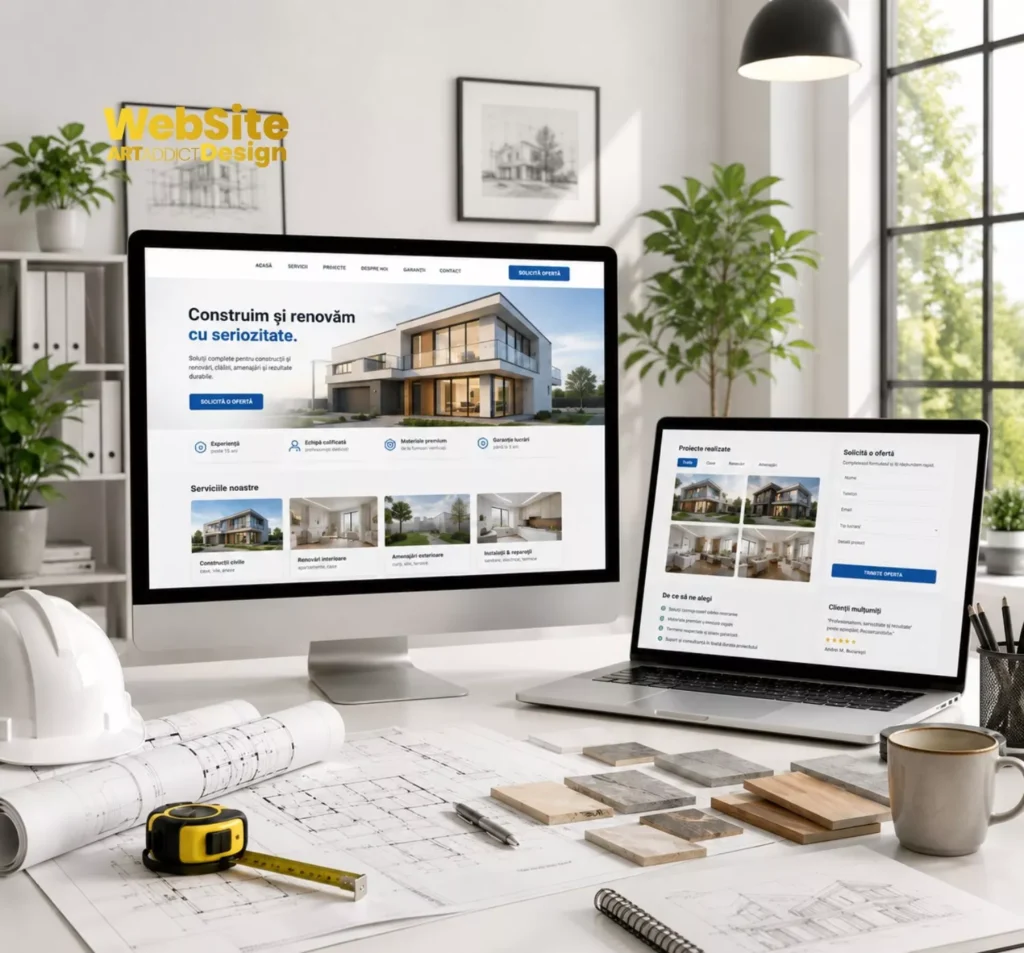
Why does the portfolio matter so much?
In construction and repairs, the portfolio is one of the most powerful reliable elements.
The client wants to see real work. Not just nice descriptions.
A good portfolio can show:
- what types of projects you are doing;
- the quality of the execution;
- attention to detail;
- the style of the works;
- the level of complexity;
- The firm's experience.
Many firms lose confidence because they do not present their work correctly. They have weak pictures, random images or galleries without explanation.
A good portfolio doesn't just mean a lot of pictures. It means clearly presented works.
For each project you can include:
- type of work;
- general location;
- what has been accomplished;
- the indicative duration;
- important challenges or details;
- photos before and after, if any.
These details help the client to imagine more easily how the firm could work for him, too.
How does the site help to position the firm?
If the website says the firm does "anything for anyone," there's a good chance it'll attract chaotic demands.
Positioning clearly helps a lot.
The website should be understood:
- whether you work in a residential or commercial capacity;
- if you do complete construction or renovations;
- whether you specialize in finishing, repairs, facilities or large projects;
- whether you work with individuals, developers or companies;
- in which areas of Romania you take over projects;
- What type of works you best fit.
The clearer the positioning, the more suitable the applications become.
A customer seeking renovation of the apartment does not have the same needs as a company that wants to arrange a commercial space. The site must speak on the language of each type of client.
See what our service includes site creation for construction and repair firms.
Why does "About Us" page matter in construction?
For many companies, the "About Us" page is treated superbly. However, in construction, it can play an important role.
The client wants to feel he's working with a real, serious and organized firm.
On this page you can explain:
- who you are;
- what experience you have;
- what types of work you do;
- how you approach projects;
- what you value in your relationship with the client;
- how you communicate during the work;
- that differentiates you.
Avoid very general texts of the type:
Suntem o echipă tânără și dinamică, orientată spre calitate și profesionalism.A better option:
Realizăm lucrări de construcții, renovări și amenajări pentru clienți care au nevoie de o echipă organizată, comunicare clară și rezultate bine executate. Punem accent pe planificare, detalii și respectarea etapelor discutate.This wording transmits more maturity and confidence.
What's the role of the contact page?
The contact page does not have to be just an address and a phone number.
For construction firms, the tender needs to be well thought out. The more relevant information the customer sends, the more effective the first discussion becomes.
A good form may require:
- the name;
- the telephone number;
- the locality;
- type of work;
- the approximate area;
- whether there is a project, plan or blueprint;
- the time limit required;
- indicative budget, where appropriate;
- description of the work;
- the possibility to upload images.
This type of form helps the firm to receive clearer requests and reduces "how much" messages.
How does the website help Google?
A good site doesn't just help the company's image. It also helps Google to better understand what services you provide.
If the site has clear pages, relevant texts, portfolio, articles and logical structure, it can attract organic traffic from commercial searches.
Examples of useful searches:
- construction firm in Romania;
- company renovation apartments;
- interior fittings;
- repair apartments;
- building houses;
- construction firm Bucharest;
- Company renovations Iasi;
- interior landscapes Cluj;
- construction company Timișoara.
For SEO, it is important that each page has a clear purpose. The homepage must not attempt to ranker for all services. The dedicated pages can target the specific searches better.
What's the role of the blog for a construction firm?
A blog can be very useful if used correctly.
People often look for questions like:
- how much it costs to renovate an apartment;
- including a complete renovation;
- how to choose a construction firm;
- what you need to know before the renovation;
- how long an interior arrangement takes;
- what mistakes are to be avoided when renovating;
- how you prepare an offer.
Through useful articles, the company can attract visitors from Google, educate potential customers and build trust before contact.
The blog doesn't have to be just informative. It must support the commercial pages and send users to tender.
Mistakes reducing the quality of applications
1. Services too vague explained
If the man doesn't understand exactly what the firm is doing, he'll send out confusing or inappropriate requests.
2. Lack of real work
In construction, pictures and projects matter a lot. Without the portfolio, the site inspires less confidence.
3. General texts
Forms such as "quality and professionalism" are not sufficient. The client needs concrete details.
4. Weaknesses in contact form
If the form only requires name and phone, the applications will be harder to filter.
5. Old or disorderly design
A chaotic site can convey the idea that the company works the same way.
6. Lack of dedicated pages
A single page for all services can limit both the clarity and the SEO.
7. Lack of work process
The client wants to know what comes after asking for the offer. If the process is not explained, uncertainty arises.
What does a website look like that brings better demands?
A good site for a construction firm should be:
- clear;
- modern;
- easy to use on the mobile;
- well-structured;
- Confidence-oriented;
- Rich in real works;
- written to the customer;
- Thought for calls for tender.
Recommended minimum structure:
- Homepage,
- Services;
- Separate pages for important services;
- Portfolio / works;
- About the company;
- Working process;
- Contact;
- Frequently asked questions;
- Blog.
If these elements are done correctly, the site can become a real tool for selling, not just an online presence.
What's worth remembering
A good site can help a construction, renovation or repair company to receive more serious requests because it explains the services more clearly, inspires confidence and better filter customers.
Many firms lose good demands not because they work poorly, but because they do not present themselves clearly enough online.
A well thought-out website shows what the firm does, who it works for, what works it has done and how the collaboration can begin. And all this helps the client send a clearer and more prepared request.